
Early Embden Schools

Embden resident and long-time school teacher Marie W. Cross (1906 - 2000) prepared a compilation of early Embden Schools relying on information from "Embden Town of Yore" by Ernest G. Walker, Embden Town Reports and from relatives of families who attended early schools. The information provided here is derived from Ms. Cross's research.

West Ward School or Cragin- Hutchins School #9
The first school in Embden was built to meet the needs of the many children in the Cragin, Hutchins, Cleveland and Savage families.
The town allocated $200. to build the school at a meeting on May 13, 1809. It was believe to have been completed during 1810 and was built on land owned by Simeon Cragin.
For many years it was the largest school in town, with 59 pupils registered in 1853. The date it closed is not known but is presumed to be before 1869.
Wentworth School #8
On October 13, 1821 the town voted to form a school for the James and Andrew Wentworth families, and their neighbors, the Burns, the Pierces, and the Clevelands. Twenty-seven children began their education here.
The first schoolhouse was a log cabin a few rods above the William McKenney stone house on the Foss Hill Road. Later it became necessary to have a larger building and a framed schoolhouse was built in the northwest corner of the town road at the junction of Wentworth Lane.
Barron School #7
On April 1, 1816, at the annual town meeting it was voted to permit Elisha Walker, Joseph Barron, and others to make a school district. A schoolhouse was built north of Barron Brook on the Embden Pond Road, near the Samuel Walker house.
The school flourished for over 80 years, and is estimated to have closed around 1896.
Holbrook School #12
This school was built on the north side of the town road leading west from Holbrook corner, near the foot of Embden Pond. It was built in 1855-56 at a cost of $176.77.
Over the years it maintained a large enrollment, and many times the largest.
Schools in these early days had contests, too. Holbrook School vied with Bowen Mills and Dunbar for the highest honors numbers and scholarship.
Moulton School #10
Built around 1850 with an allocation of $150, this school served the Moulton, Green, Copp, and other families.
The school was built on the west side of the Greene Road, south of the Moulton burying ground. Students came from as far away as Concord, sometimes by ox sled.
The schoolhouse also served as a Methodist Church meeting place with occasional funerals held there.
Black Hill School #11
Located on the road from North New Portland across the foot of Hancock Pond, it is unclear when the school was built, but one was authorized in town vote in 1837.
In 1845 there were 52 pupils registered at the school, and records show it was still open in 1896.
John Wilson School #6
In 1819 it was voted to build a schoolhouse in District No. 6 at a cost of $250. It was to be 20 feet square and have two chimneys. It was to be set in the southwest corner where the road from the Kennebec River Road leading westward crossed the Canadian Trail, known as Box Trap Corner near the foot of Fahi Pond.
The first town meeting that assembled there was on August 5, 1820. From that date nearly all town meetings were held there until the building burned in 1838.
A second schoolhouse was built one mile north of the original one. In 1850 this school had 25 pupils. It remained in use into the Second School Era.
Dunbar School #5
This school was authorized on December 15, 1825, with the vote to build on Samuel Clark's land, where the road from the ferry leading westward across the Canadian Trail and continued out to Ayer Hill. The school cost $273 to build.
The school was one of the largest in town over the years. In 1860 there were 57 registered pupils.
There are recorded town meetings held at the school - in 1839 and two during the 1850s.
The school was open into the 1870s and later was used as a sheep barn.
Berry School #4
Located near the Concord Line where the Canadian Trail crossed the AI Moulton Road, the school was built in 1830, and cost $200.57.
In 1865 there were 41 pupils in this school and in 1870 there were 36.
Ernest G. Walker, author of "Embden Town of Yore," taught at this school in 1887, at which time 29 pupils were registered.
The school is believed to have closed in the early 1890s.
John Grey School #1
On March 30, 1818, the construction of this school was authorized and was to be 18 feet square set between the homes of Mrs. H. Grey and E. Cleveland on the Kennebec River Road.
The John Grey school was one of the smaller schools, with enrollments averaging 27 pupils between 1845 and 1870.
Stevens-Thompson or
the Ferry School #2
At a meeting held at Moses Thompson's house on January 2, 1819, this school was authorized at a cost of $170. The plans called for a building measuring 28 by 16 feet and "6 fifteen squared windows." The building was slated to be set near the ferry on the east side of the main road by Rueben Thompson's house.
Between 1845 and 1870 the schools had an average of 30 pupils, but enrollment grew to 69 pupils in 1833.
Bowen Mills or
Caratunk Falls School #3
This schoolhouse was erected in 1820 - 1821 near the junction of Martin Stream and Mill Stream, in northeast Embden near Bowen Mills. Construction costs were $160.97. The school was deemed unsatisfactory and replaced by a new building in 1825 at a cost of $180.
The new schoolhouse stood for almost 50 years, and averaged 47 pupils between 1845 and 1870. This school was replaced in 1873 by a new building and continued to house large classes of students.
Era II began with only five of the original twelve schools in use: John Gray, Bowen Mills, Dunbar Hill, John Wilson, and Holbrook. All had large enrollments and were one-room schoolhouses teaching grades one through eight. The school year consisted of 30 weeks, divided into terms.
In 1905, the schools were renamed:
* John Grey #1 became Purington
* Bowen Mills #3 became Hawthorne
* Dunbar Hill #5 became Longfellow
* John Wilson #6 became McKinley
* Holbrook #12 became Emerson
The Washington School, a new school, was also built during this era.
By 1914, total school enrollment for the town was 108: 91 elementary pupils and 17 secondary pupils. High school students could attend Anson Academy, Solon, Bingham, or New Portland High School.
The schoolhouses had no running water, indoor plumbing, or electricity. A woodstove heated each classroom, and it was the teacher's duty to build and tend the fire throughout the cold months. On the coldest days, everyone gathered around the stove to keep warm while doing their lessons.
Playground equipment was simple: a stick served as a bat, and a grandmother might knit or sew a ball from yarn or rags. Pupils played games like tag, drop the handkerchief, and hide and seek - games suited to a range of ages so that even the younger children could join in.
In 1918, Lettuce Bradbury was hired as the first Embden District Superintendent. In 1937, J. Arthur Green joined the town as the new Superintendent. The Superintendent visited each school several times a year, spending time listening and observing. Before leaving, he or she would offer suggestions for improvement along with praise for the teacher's and student's accomplishments.
In 1930, Dr. H.E. Marston was hired as school physician.
In 1938, electric lights were installed in all the schools.
In 1945, the first school bus route was established. Virgil Hilton owned the bus and served as driver.
As enrollment declined, schools began to close. By the fall of 1954, the school year opened with only two schools still in operation: Emerson, with 12 pupils taught by Frances Matthews, and Purington, with 27 pupils taught by Marie Cross.
Building modernization progressed with the installation of oil heaters in 1957, followed soon after by running water.
In 1960, the towns of Embden, Solon, Anson, and New Portland voted to join a new School Administrative District, forming S.A.D. #74. As part of that transition, the Central School in Embden was constructed, and students began attending in 1962.
Purington School
formerly John Gray School #1
The school closed in June of 1962 as students were transferring to the new Central Schoolhouse in the fall.
Later, the building was sold to Ronald Giguere to become his home and it was subsequently destroyed by fire.
Hawthorne School
formerly Bowen Mills #3
In 1945 the town voted to consolidate this school with the Purington School and to use the Purington building.
The Hawthorne School closed permanently in June of that year. The teacher at that time was Geraline Atwood.
In 1959 the building was sold to Norman Waugh.
Longfellow School
formerly Dunbar #5

The Longfellow School was built in 1897 in the Dunbar Hill area, about halfway between the sites of the old Berry School #4 and Dunbar #5. It was near the Embden Center Post Office.
After 38 years of service the school closed in 1935 due to low enrollment. In 1950, the Town voted that the schoolhouse be sold to Gladys Carl for $150. The teacher at that time was Carolyn Waugh.
McKinley School
formerly John Wilson #6

In 1915 the enrollment at this school was 13 pupils.
The school was closed in June of 1941 due to low enrollment. Ardella Allen was the teacher at that time.
In 1950 the town voted to sell the schoolhouse to Norman Rickards for $155. On May 17, 1951 the building was destroyed by fire.
Washington School
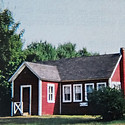
In 1915 there were 14 pupils registered at this school.
Records found at the school list several teachers.
From the 1920s:
-
Bertha Young
-
Grace Berry
-
Harriet Ham
-
Chestina Dawes
-
Hermaline Boyd
-
Alta French
From the 1940s and 1950s:
-
Mildred Jackson
-
Frances Matthews
The school closed in June of 1954 due to low enrollment. Frances Matthews was the teacher at that time. Students went to the Emerson school in September of 1954.
The town deeded this schoolhouse to the Embden Extension Association for their meetings in 1956.
Emerson School
formerly Holbrook #12

Sometimes this school was referred to as Fort Holbrook. It was located near the foot of Embden Pond.
For several years, the Methodist Church society of North Anson held church services in this schoolhouse. The society also owned land across from the school where they built a horse shed for hitching their horses while the people attended church.
The school served as sort of a community center, with holiday programs and graduations held there in addition to the church services.
In 1935 the school had an enrollment of 34 pupils.
After having served the town for 107 years, the Emerson School was closed in June of 1962 as students transitioned to the new Embden Elementary School. Alberta Philpot was the teacher at this time.
The school was sold to Samuel White, Sr. in 1963, and was used as his residence for many years.